For a long time, I had a rule I didn't even know I had.
Reach out once. Maybe twice. If they didn't respond, I told myself they weren't interested and I moved on.
I called it respecting their time. Looking back, I was just afraid of being annoying. So I let good leads go cold because I ran out of things to say that didn't feel pushy or generic.
I've talked to enough real estate agents to know this pattern isn't unique to me. Most agents follow up once or twice, hit a wall, and stop. Not because they don't care about the lead. Because they don't know what to say next.
Quick Answer
Research shows that 80% of sales require at least five follow-up contacts after the initial conversation. Most real estate agents stop after one. The gap between those two numbers is where deals disappear. The real problem isn't motivation. It's the message. Agents who have the right words ready at every stage of follow-up close more deals because they stay in the game longer.
In this article, you'll learn:
- What the research actually says about follow-up and closing rates
- Why agents stop following up (it has nothing to do with laziness)
- What a real follow-up message looks like versus a weak one
- How AI gives you a starting point for every follow-up situation
- How to stop losing deals you should have won
The Numbers Are Worse Than You Think
Let's start with the data, because it's worth sitting with.
According to research compiled by ZoomInfo, 80% of sales require at least five follow-up contacts after the initial conversation. But 44% of salespeople give up after the very first attempt. Another 22% stop after the second.
That means the majority of salespeople never make it to the point where most buying decisions actually happen.
In real estate, the numbers are even harder to look at. Research from AgentZap found that 48% of real estate agents never follow up with a lead after the initial contact. Not once.
The agents who follow up consistently are converting at rates 70% higher than those who don't. That's not a marginal difference. That's a different business outcome.
And it's not because those agents are better at selling. It's because they're still in the game when the buyer or seller finally makes a decision.
Why Agents Stop Following Up
It's not because they don't care.
Every agent I've talked to knows follow-up matters. They've heard it a hundred times. "The fortune is in the follow-up." "Stay top of mind." "Keep showing up." They know. They still stop.
Here's what actually happens.
You reach out once. No response. You reach out again. Nothing. Now it's been two weeks, and the longer you wait, the harder it gets to pick up that conversation without it feeling awkward. You start running the story: they found another agent, they're not ready, I don't want to bother them.
So you move on. The lead goes cold. Three months later you find out they listed with someone else.
The problem isn't motivation. It's not having the right words ready when you need them.
"The agents closing more deals aren't always better at selling. They're just still in the game."Barton Eby
The Real Problem Is the Message
Most agents don't follow up because they don't know what to say that doesn't feel like "just checking in."
And "just checking in" is not a follow-up. It's a reminder that you exist. It gives the person nothing. No reason to engage, no useful information, no question worth answering. It puts the entire burden on them to think of something to say back.
Most people won't bother. So they don't respond. And the agent interprets that as a signal to stop.
A real follow-up gives the reader something. A piece of market information that's relevant to what they're looking at. A question that moves the conversation forward. Context that helps them make a better decision. Something that positions you as someone who's paying attention and looking out for them.
Writing that kind of message from scratch for every lead at every stage of follow-up takes time. If you're juggling 20 prospects in different phases of the buying or selling process, sitting down to craft a thoughtful, personalized message for each one isn't realistic. So most agents don't.
They send nothing, or they send "just checking in." Neither one moves the needle.
What the Difference Looks Like Side by Side
Here's a concrete example. A buyer toured a home last week in the $400,000 range. They said they needed to think about it. You haven't heard back since.
The second version does something. It gives Sarah a reason to engage. It positions you as someone who's watching out for her interests. And it doesn't ask her to buy anything. It just gives her information that's worth having.
That's what follow-up is supposed to do. And that's exactly what most agents never send, because they can't figure out how to write it quickly enough to do it consistently.
How AI Changes the Follow-Up Equation
Writing the second version of that message from scratch every time isn't practical.
But here's what is practical. Having a prompt that does most of the work for you.
When you have a purpose-built prompt for a specific follow-up situation, you don't start from a blank screen. You open the prompt, plug in a few details. Who the buyer is, what they looked at, what price range, what they said when you last spoke. And you get a solid first draft in about 30 seconds. Something you can review, personalize slightly, and send in two minutes.
Not a generic output that sounds like it was written by a robot. A starting point that's already calibrated for that specific situation and that actually sounds like something a real person would send.
That's the difference between AI that saves you time and AI that wastes it. The tool is the same. The prompts are what make it work.
The Situations Where Follow-Up Prompts Matter Most
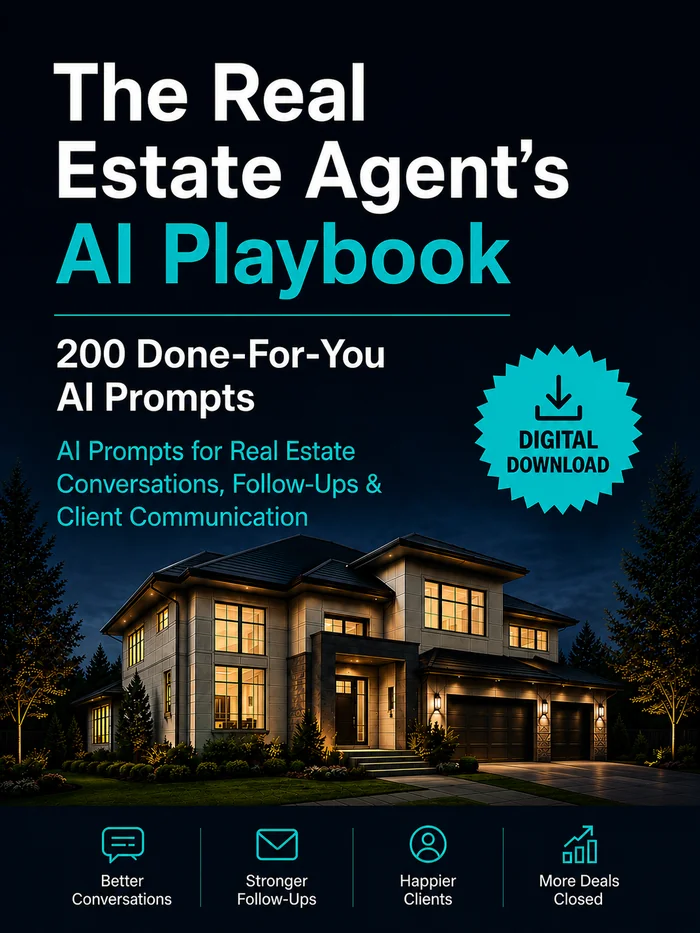
Not all follow-up situations are the same. Each one requires a different approach, a different tone, and a different angle. The prompts I built for The Real Estate Agent's AI Playbook cover the specific scenarios agents run into most often.
- Buyers who said they need to think about it after a showing
- Leads that went quiet after an initial inquiry
- Sellers who are on the fence about timing
- Prospects who asked about the market but never followed through
- Past clients you haven't spoken to in months
- Buyers who lost a home to another offer and went cold
Each one of those is a distinct situation. Each one calls for a different message. And having a prompt ready for each one means you're never staring at a blank screen trying to figure out what to say.
See the follow-up prompts for yourself.
The Real Estate Agent's AI Playbook includes a full section of done-for-you follow-up prompts built for the situations agents face every day. See what's inside →
Follow-up is one of five places AI is saving agents real time right now. See the other four in 5 Ways Real Estate Agents Are Using AI to Close More Deals Faster. And for a closer look at getting AI to write those follow-up messages so they actually sound like you, see How to Use AI to Write Follow-Up Emails That Actually Sound Like You.
Key Takeaways
- 80% of sales require 5 or more follow-up contacts. Most agents stop after one or two.
- The reason agents stop following up isn't motivation. It's not knowing what to say that doesn't feel pushy or generic.
- A good follow-up gives the reader something useful. Information, context, or a reason to engage that has nothing to do with "are you ready yet."
- AI built around purpose-built prompts gives you a strong starting point for any follow-up situation in under a minute.
- Consistent follow-up is a process problem, not a talent problem. Build the process and the results follow.
The Fortune Is in the Follow-Up. Now You Have the Words.
I heard that line for years and agreed with it in theory while doing almost nothing about it in practice.
The issue was never that I didn't believe it. It was that I didn't have a reliable system for what to say at each stage, so I defaulted to silence or generic check-ins that went nowhere.
Once I had the right prompts in place, that changed. Not because I became a different person or a better writer. Because I stopped trying to construct the perfect message from zero every single time.
If you're a real estate agent and you're still losing leads because you run out of things to say after the first or second contact, this is exactly the problem the AI Playbook is built to solve.
You don't have to figure out what to write. You just have to have the right prompt ready and be willing to actually send it.
If you want to understand why generic AI prompts don't work — and what makes a purpose-built prompt different — this piece on building a prompt library covers that in detail. If listing descriptions are eating your time, here's how AI handles those too. And if you want a practical framework for writing better prompts yourself, this guide on AI prompts that actually sound like you walks through exactly what to include.